Blog
Circles versus squares
Zoom, Teams or Meet: a tidy grid of square boxes, neatly side by side. Everyone the same size, everyone the same distance away, everyone equally quiet. And still we expect that setting to produce energy.
Zoom, Teams or Meet: a tidy grid of square boxes, neatly side by side. Everyone the same size, everyone the same distance away, everyone equally quiet. You're forced into following along passively. Walking off, or having a quick one-to-one, isn't an option. You're stuck. So is everybody else. And still we expect that setting to produce energy.
Your surroundings steer your behaviour
In a physical space we feel it at once. A meeting room with a long table and a projector on the wall says: presentations happen here. A circle of loose chairs says: we're going to talk. A foyer with standing tables says: walk around, make contact. The layout decides what people do before anyone has said a word.
In Teams or Zoom it works exactly the same way. You open the link. Everyone appears, neatly, in the grid. The shape says: listen, wait your turn, sit still.
What a grid does to you
In a grid everyone is equal. That sounds democratic, but the effect is the opposite. You see the same amount of everyone, and you aren't really in contact with anyone. There's no near, no far. You can't step aside with two people. You can't use your body to show you want to be part of something. The only way to signal you're there's to unmute. And almost nobody does.
Then there's the noise. In a grid every participant brings their own visual world. Your kitchen, your bookshelf, the cat, light that refuses to cooperate. No shared context, no common environment to give the conversation direction.
What changes when you can move
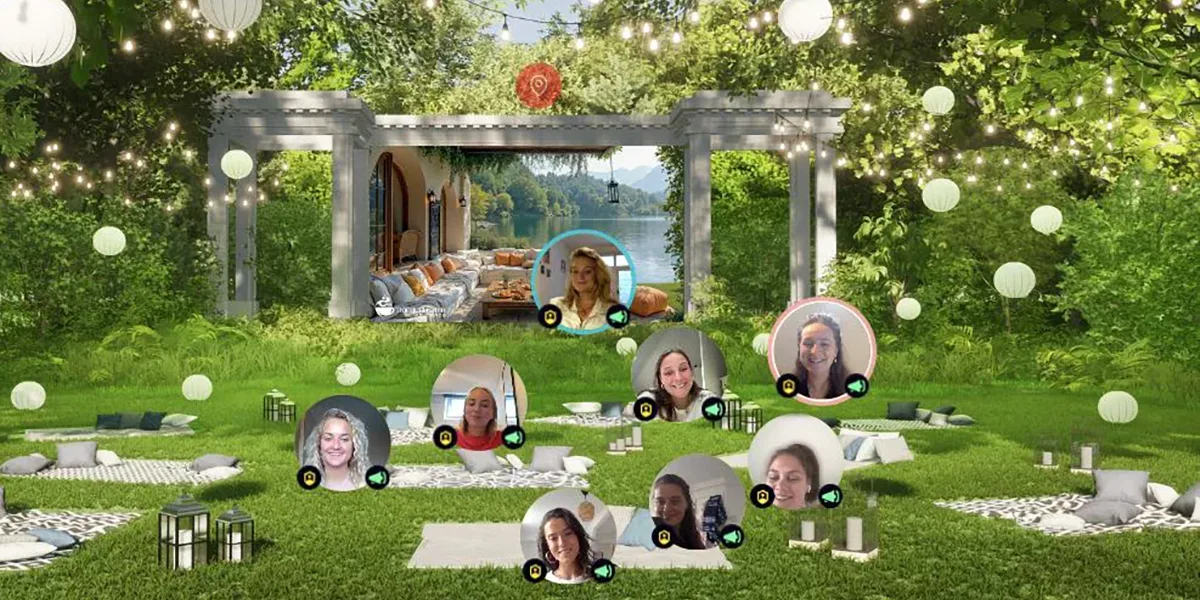
There are online environments where you aren't stuck in a box. Where you move through a shared space as a circle, decide for yourself where you go, step closer to someone or take a bit of distance instead. Where your voice softens as you walk further away, just as it does in real life.
That changes how everyone behaves. In a grid you wait. In an open space you move. And that difference decides whether you get a conversation or a broadcast. In a grid one person asks a question. In a space five conversations start at once. People join something, listen in for a while, wander over to another group. They make micro-choices, just as they would at a physical event. And those choices are the difference between a meeting and a place.
Shared space instead of individual noise
In a space where everyone moves around as a circle, you share more than you contribute in noise. Your face is small, and so is your background. What is large is the shared space. And you can tailor that completely to what you're doing. A strategy session gets a different backdrop than a drinks reception. An onboarding looks different from an off-site. The environment brings atmosphere and functional structure at once. You can see where the break-outs are, where the plenary space is, where the coffee corner sits.
In a grid the environment is neutral. In a designed space the environment is part of the design.
When a grid works and when it doesn't
A grid is perfectly fine when you want to broadcast. A presentation, an update, an announcement. One-to-one works fine too. Up to about eight people you can often still get away with it, because the group is small enough for social pressure to do its work. But as soon as you expect people to talk to each other, as soon as the group grows, the shape works against you.
Sit, or walk
So when you're organising an online session for a larger group, don't let the starting point be which tool you use. The first question is: do I want people to sit and listen, or do I want them to move and talk to each other? That answer decides the shape. And the shape decides what happens.
PS. We work with SpatialChat, an online environment built during the pandemic by someone who wanted to drink cocktails online with friends. Not meet, not present. Just be together, and walk away from a conversation when the energy has gone out of it. You can feel that origin in how it works. Curious? Book an introduction and we'll show you.
Emilie van Rappard
Founder of MeetingMasters. Writes about meaningful gatherings at a distance — online events, virtual offices and human connection.