Blog
Not the same. Still good.
Most gatherings weren't good before they went online. Online only made it more visible: the problem is rarely the medium, but the form and the design.

Most gatherings weren't good before they went online. Online only made it more visible. The awkwardness, the drifting off, the lack of energy or focus: it was usually already there. The problem is rarely the medium. The problem is the form. And the design.
Even so we keep comparing online and offline as if they were two versions of the same thing. As if an online gathering is by definition a substitute for a real one. That frame runs deep. And it gets in the way of good design.
The wrong starting point
Comparing online and offline is a strange thing to do, really. We compare a physical gathering that has often been allowed to exist unquestioned for years with an online version that suddenly has to prove it's just as good. In doing so we forget how poorly many physical gatherings are set up. Long plenary sessions. One-way traffic. Barely any interaction. Vague goals. Nobody asking what this gathering is actually meant to produce.
Offline has a head start because we're used to it. Not because it's better.
Online takes that givenness away. Everything that doesn't add up becomes visible. Talk too long and you're looking at blank cameras. Leave no room for interaction and you lose people. Design no rhythm and you feel the energy drain. That's confronting. It's also valuable.
Start with the goal, not the medium
At MeetingMasters we always start with the same question: what has to happen here? Not: is this online or offline? But: what is the goal, who is coming, what do they need to be able to do, experience or decide?
Only then comes the medium. Sometimes that's offline. Sometimes hybrid. And very often online.
For certain goals online isn't a compromise but the better choice. Think of international groups. Of equality in conversation. Of lowering the threshold to speak up. Of speed and frequency. Of sustainability. Of focus.
Online lets you design the form far more explicitly. That asks for more thinking beforehand, but it gives more back too.
Method does the heavy lifting
What we see time and again: most of it's solved by method. By making choices about formats. By building rhythm. By alternating between listening, thinking and doing. By involving people actively instead of letting them consume passively.
Good online gatherings are rarely spontaneous. They're designed. So are good offline gatherings, for that matter — we have simply grown less strict about those.
Method helps steer behaviour. Deepen conversations. Make room for different voices. Keep energy up. That holds online and off.
The difference is that online offers no escape routes. You can't hide behind a venue, a stage or a long lunch break. If the design doesn't work, you feel it straight away.
Form as an extra layer
On top of that comes the platform. Not as a trick, but as context. The form you place people in shapes how they behave. That's true offline, and just as true online.
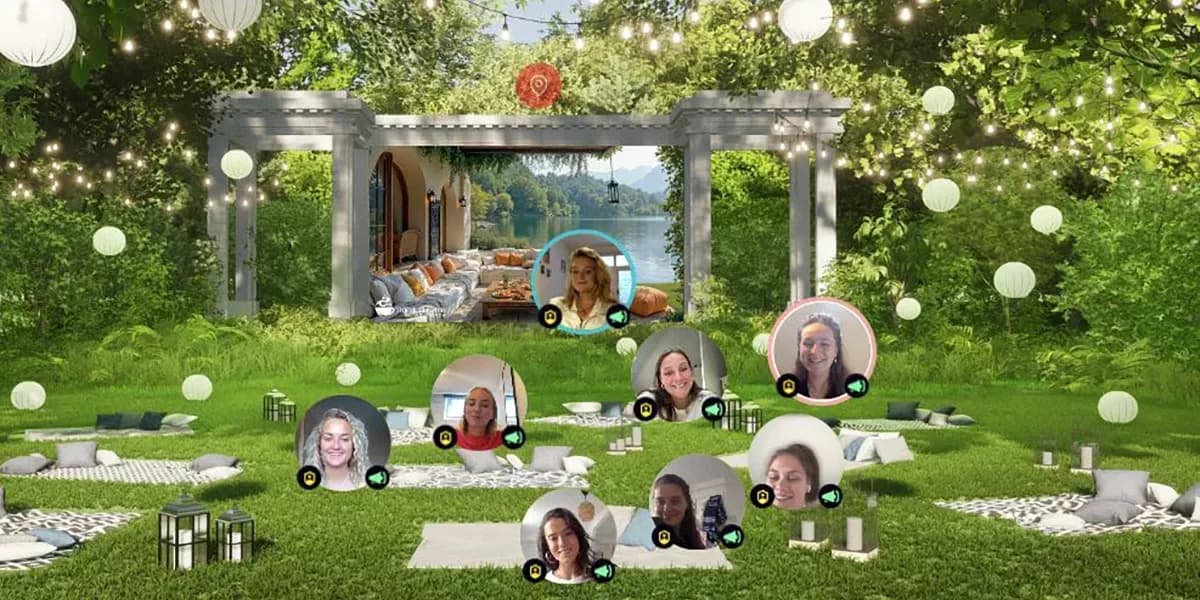
Platforms like SpatialChat add a layer that many traditional video platforms lack. Not a rigid grid of heads, but space. Distance. Closeness. Movement. Freedom to choose.
People decide for themselves where they stand, who they talk to, when they join or leave. That sounds simple, but the effect is large. Conversations start more naturally. Networking feels less forced. Silence is allowed. So is observing.
That spatial quality makes it possible to do something online that offline often seems obvious but in practice is rarely set up well: informal encounter.
Context steers behaviour
In a physical space everyone accepts that context shapes behaviour. A theatre invites you to listen. A café to talk. A meeting room to hold formal discussions. Online we often forget that, and put everything into the same Zoom or Teams format.
SpatialChat shows that online context can be designed too. With zones. With distance. With visual cues. Not to make it fun, but to support behaviour that fits the purpose of that moment.
That asks organisers to think differently. Less from the technology. More from the experience. What has to happen here? And which form helps with that?
Online isn't less human
A stubborn misunderstanding is that online would be less human. What we usually mean is: badly designed online gatherings feel distant. But that applies just as much to badly designed physical ones.
Humanity isn't in the medium. It's in attention. In room to respond. In being seen and heard. In pace. In taking participants seriously.
Well-designed online gatherings can actually be more inclusive. People who are slow to speak up in a full room will do so in a smaller online setting. People who find travel hard can still take part. People who normally sit at the back get as much room as anyone else.
Stop defending, start designing
As long as we keep defending online against offline, we stay tense. We try to imitate what we know instead of using what is possible. The question isn't: how do we make online as much like offline as we can? The question is: how do we design gatherings that do what they need to do? Sometimes that's offline. Sometimes online. Sometimes a clever combination. But always chosen on purpose.
Online made visible what wasn't working already. That isn't a problem. That's an opportunity.
Emilie van Rappard
Founder of MeetingMasters. Writes about meaningful gatherings at a distance — online events, virtual offices and human connection.